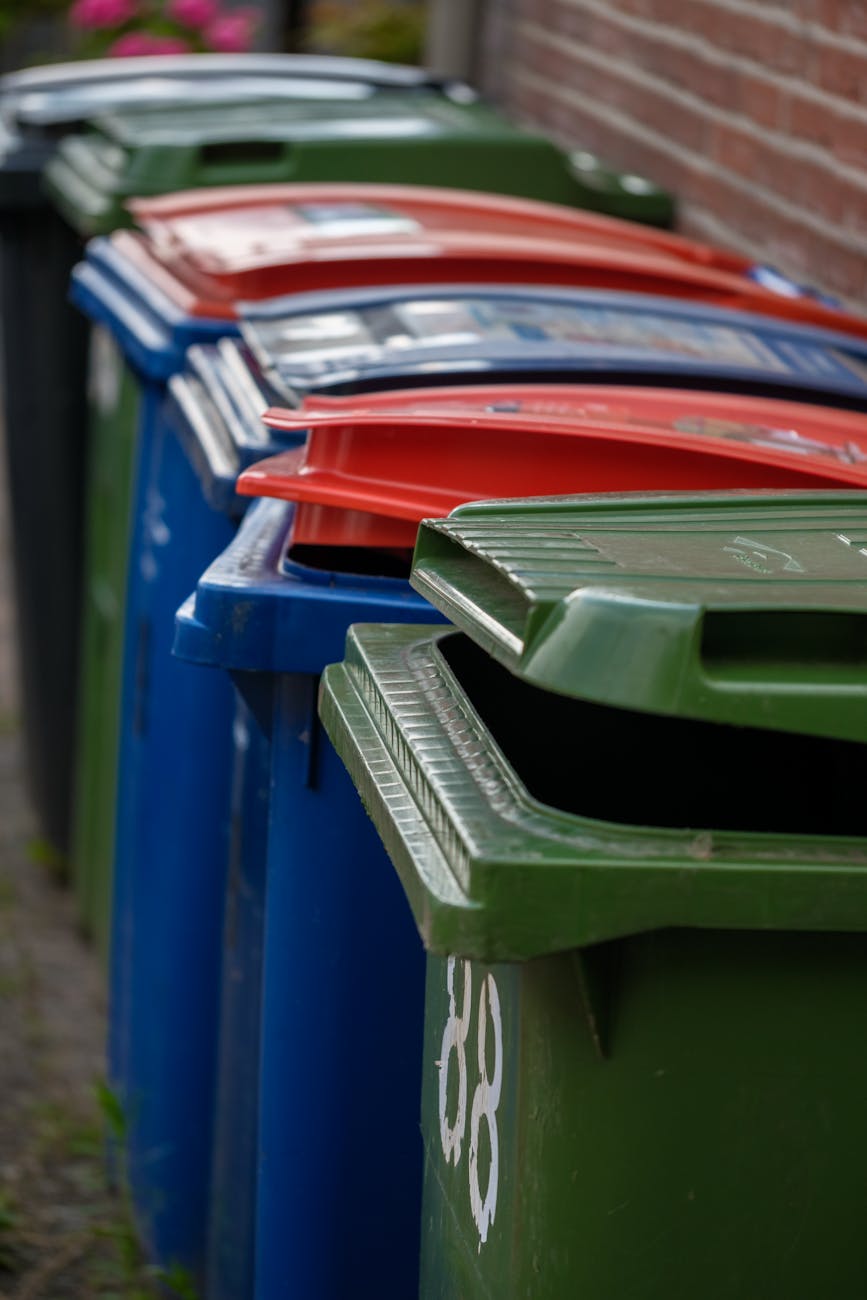
The bins line up along the curb,
Black, green, blue in orderly rows.
We leave them out before the dawn,
Then watch them disappear and go.
Out of sight by afternoon
But not gone quite as soon.
Every week, my town participates in the same ritual. The night before collection day, garbage cans appear along driveways and sidewalks, and by morning, the streets are lined with them. Then the trucks arrive, lifting each bin with mechanical precision, and within a few hours, everything is gone. Or at least, gone from our view.
For the most part, I never thought much about what happened next. The truck took it away, and that was the end of the story. However, as expected, it wasn’t that simple.
In New Jersey alone, millions of tons of municipal solid waste are generated every year. After collection, most household trash is taken to transfer stations, where waste from multiple trucks is combined, sorted, and prepared for transport. From there, it may travel to a landfill, an incinerator, or another processing facility (New Jersey Department of Environmental Protection).
Surprisingly, a lot of New Jersey’s trash doesn’t stay in New Jersey because land is limited and disposal is expensive. Significant amounts of waste are transported to landfills in neighboring states, particularly Pennsylvania. Some trash may travel up to hundreds of miles away (New Jersey Department of Environmental Protection; Pennsylvania Department of Environmental Protection).
From there, it ends up in a landfill. Despite the name, modern landfills aren’t simply giant holes in the ground. They’re engineered facilities designed to contain waste, designed with layers of clay and plastic liners to help prevent contamination from leaking into groundwater. Pipes collect methane gas produced as garbage decomposes, while other systems collect leachate, a polluted liquid formed when water filters through waste (U.S. Environmental Protection Agency).
But even with these protections, landfills are far from perfect. Food scraps and organic materials buried without oxygen produce methane, a greenhouse gas considered worse than carbon dioxide in the short term, while plastics can remain intact for centuries. The average landfill is less a place where things disappear than a place where they are stored.
Some waste avoids the landfill entirely through incineration. New Jersey operates several waste-to-energy facilities that burn garbage and use the heat to generate electricity (New Jersey Department of Environmental Protection). Supporters argue that this reduces landfill use and recovers energy. Critics cite air pollution concerns and argue that incineration can discourage waste-reduction efforts. Neither option is that great.
We treat disposal as the end of an object’s life, but it’s really just the beginning of another journey. A plastic container might sit in a landfill for hundreds of years. A banana peel might become methane gas. A worn-out shirt might travel across state lines before reaching its final destination.
The truck doesn’t make our trash disappear. It just moves the problem somewhere else.
 the nature diaries
Leave a comment